

Running a commercial aquatic facility in Australia is a fundamentally different responsibility from maintaining a backyard pool. The volume of users, the regulatory obligations, the equipment demands, and the consequences of getting something wrong are all magnified in a commercial setting. A residential pool owner who lets their chlorine slip for a week ends up with cloudy water. A commercial facility operator who lets water quality standards lapse may face a public health closure, regulatory action, and serious reputational damage.
Yet many operators of commercial pools, including those at hotels, fitness centres, schools, and residential complexes, underestimate the complexity of what they are managing. They treat commercial aquatic facilities with a residential mindset, applying the same ad-hoc approach to testing and chemical management that might just about work in a backyard but falls well short in a high-use, regulated commercial environment.
This article addresses the key responsibilities of commercial pool management in Australia, from the regulatory framework and water quality standards through to equipment requirements and the role of professional cleaning and maintenance services in keeping a commercial facility running safely and efficiently.
The Regulatory Framework for Commercial Aquatic Facilities
Commercial aquatic facilities in Australia operate under a regulatory framework that does not apply to residential pools. Understanding this framework is the starting point for any operator’s compliance obligations.
At the state level, public swimming pools are regulated under public health legislation. In most Australian states, swimming pools that are accessible to the public or to paying members are classified as regulated premises, which means they are subject to inspection by local councils or public health authorities and must demonstrate compliance with applicable water quality standards.
The relevant standards are typically set out in state-specific public health guidelines or regulations. Common requirements include:
- Free chlorine concentration maintained within a specified range, typically 1 to 3 parts per million for non-heated pools and up to 3 to 5 parts per million for heated facilities where higher bather loads and temperatures increase demand
- pH maintained within 7.2 to 7.8
- Combined chlorine (chloramines) below 1 part per million, since combined chlorine creates the characteristic pool chemical smell and is associated with eye and respiratory irritation
- Water clarity sufficient for the pool floor to be visible in the deepest area of the pool
- Record keeping of test results at specified frequencies, typically two to four times per day for heavily used commercial facilities
These are minimum requirements. The actual performance standards a well-operated commercial facility should aim for are typically more demanding than the regulatory minimums, because the regulatory minimums represent the floor below which action is taken, not the standard of care that responsible operation involves.
Bather Load and Its Effect on Chemical Demand
The most significant difference between managing a residential and a commercial pool is the bather load. Every person who enters a pool introduces organic matter into the water: sweat, sunscreen, cosmetics, and other substances that react with chlorine to form chloramines, consuming the active sanitiser in the process.
A residential pool used by a family of four places relatively modest demand on the sanitisation system. A hotel pool used by 40 guests in the course of a day, or a fitness centre lap pool used by 200 members across multiple sessions, places an entirely different order of demand on the water chemistry.
Commercial facilities must calculate their anticipated bather load and design their water treatment system to handle it. This includes:
Chemical dosing capacity. A manually dosed commercial pool, where an operator adds chemicals on a schedule, is inadequate for a high-use facility. Commercial pools require automated chemical dosing systems that monitor pH and free chlorine continuously and add correction chemicals in real time as demand fluctuates. These systems prevent the swings in water chemistry that manual dosing cannot avoid in a high-use environment.
Turnover rate. The turnover rate is the time taken for the entire pool volume to pass through the filtration and treatment system. Commercial facilities require shorter turnover times than residential pools: typically two to six hours for most commercial pool types, compared to eight or more hours for a residential pool. Achieving the required turnover rate demands correctly sized circulation pumps and filtration systems, not the residential-scale equipment that is sometimes installed in smaller commercial facilities.
Backwash frequency. Higher bather loads introduce more suspended particles into the water, loading the filtration system more rapidly than a residential pool. Filter backwashing frequency must be responsive to actual filter pressure rather than a fixed schedule.
For operators reviewing their filtration and circulation setup, consulting specialists in quality commercial pool system design and maintenance provides the technical context for assessing whether the current system is genuinely adequate for the facility’s demand profile.
The Role of Professional Pool Cleaning Services in Commercial Facilities
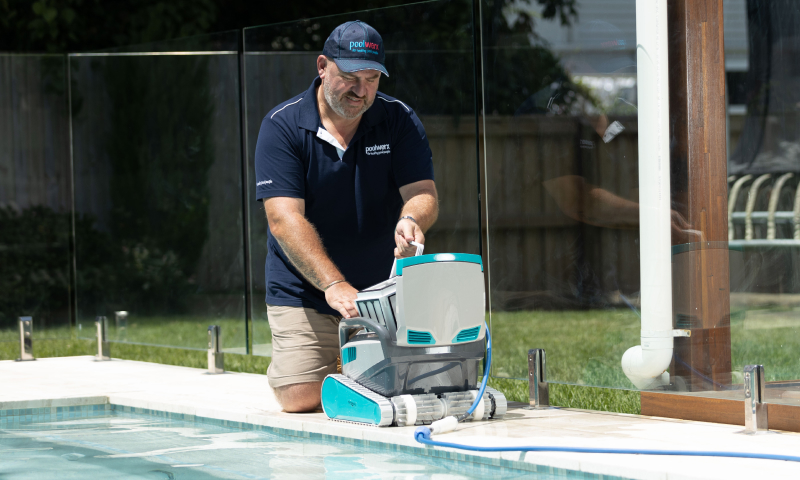
A commercial aquatic facility’s cleaning and maintenance program has two components that are distinct but interdependent: the automated systems that run continuously, and the manual cleaning that removes the debris and biological matter that automated systems cannot address.
Professional commercial pool cleaning services for aquatic facilities cover:
Vacuum cleaning. Commercial pools accumulate fine debris on the pool floor that disrupts water clarity and provides a substrate for biological growth if not removed regularly. Vacuuming frequency depends on the pool’s location, surrounding vegetation, bather load, and filtration system. For a high-use commercial facility, weekly or more frequent vacuuming is typically appropriate.
Tile and waterline cleaning. The waterline is where oils and organic matter from bathers concentrate. This builds into a scum line that is both aesthetically poor and an indication of chemical imbalance. Regular waterline cleaning removes this accumulation and provides a visual indicator of water chemistry management.
Pool deck and surrounds. The area surrounding a commercial pool is a significant infection control consideration. Wet surfaces, foot traffic, and proximity to chemical storage all require a cleaning and maintenance approach that is more systematic than most operators apply.
Equipment inspection during cleaning visits. A professional cleaning service that inspects equipment condition during each visit provides an additional layer of early fault detection. A deteriorating pump seal, a failing pressure gauge, or an automated dosing system that is delivering inconsistently are problems that professional cleaning staff encounter before they become critical failures.
Pool Heating in Commercial Facilities: Performance and Efficiency
Heated water extends the usable hours and seasons of any commercial aquatic facility, but the heating decisions made for a commercial pool carry much more significant financial and operational implications than those made for a residential pool.
The heating load of a commercial facility is substantially larger than a residential equivalent. A commercial lap pool or training facility that maintains water at 27 to 28 degrees Celsius across all seasons faces an ongoing heating demand that requires both correctly sized heating equipment and efficient fuel selection to manage costs.
Heat pump technology has become the dominant choice for commercial pool heating in Australia, largely because of its efficiency advantage over direct gas heating in moderate-temperature conditions. Heat pumps deliver three to five units of thermal energy for every unit of electrical energy consumed, making them significantly more cost-effective to operate than gas at current electricity and gas prices.
Solar thermal remains a viable supplementary technology for commercial outdoor facilities in high-solar-access locations. For pools that need to be maintained at modest temperatures above ambient rather than heated to a specific target regardless of conditions, solar can substantially reduce the load on the primary heating system.
Gas heaters retain specific advantages for commercial facilities: rapid heat-up capability is valuable for pools that are not maintained at temperature continuously, and performance is consistent regardless of ambient air temperature (which affects heat pump efficiency).
Reviewing the full range of commercial pool heating options available for Australian aquatic facilities provides a useful framework for evaluating which combination of technologies suits a specific facility’s usage profile and budget.
Water Testing Frequency and Record Keeping
Commercial pool operators in Australia are generally required to test and record water quality parameters at specified intervals. The specific requirements vary by state and by facility type, but the general expectation for a publicly accessible swimming pool is:
- pH and free chlorine tested at minimum two to four times per day, with more frequent testing during peak use periods
- Combined chlorine and total alkalinity tested at least daily
- Calcium hardness, stabiliser, and TDS tested at least weekly
- Turbidity assessed visually at every testing interval, with physical measurement required in some jurisdictions
These records must be maintained for a specified period, typically two years in most Australian states, and must be available for inspection by public health authorities on request.
A record keeping system that is built into the daily operational routine of the facility, rather than treated as an administrative task separate from pool operations, produces the consistent documentation that regulatory compliance requires and provides the operational data that helps identify trends before they become problems.
Conclusion
Managing a commercial pool in Australia is a significant operational responsibility that demands a higher standard of knowledge, equipment, and systematic practice than most operators initially appreciate. The regulatory requirements exist because poorly managed commercial aquatic facilities pose genuine public health risks, and the consequences of non-compliance extend well beyond the inconvenience of a residential pool problem.
The operators who manage commercial aquatic facilities most effectively are those who invest in appropriately scaled equipment, implement systematic monitoring and record keeping, engage professional cleaning and maintenance services, and stay across the regulatory requirements applicable to their facility type and location. That investment returns in facilities that are consistently safe, consistently appealing to users, and consistently compliant with the obligations of commercial pool operation.